Publications
Publications written for KTAG and written by us
Can Fractional Resources Work for MSPs?
Written by Paolo Del Nibletto and eChannelNEWS.
https://www.e-channelnews.com/can-fractional-resources-work-for-msps/
Fractional IT services is sort of a new thing in the IT space. It enables organizations part‑time access to senior‑level expertise, often in roles like virtual CIO, IT director, project architect, or cybersecurity strategist.
In 2025 running into 2026 fractional IT has surged beyond the concept stage for one main reason: the need for high‑level technology leadership without the cost of full‑time executives.
For MSPs, this shift is accelerating: the industry is moving from ticket‑based support to fractional CIO‑style advisory, where providers guide business outcomes, modernization, and AI adoption.
According to Houston, Tex.-based Alchemy Consulting, the global fractional executive market including fractional CIOs, CTOs, and CISOs has surpassed $5.7 billion as of 2024 to 2025. Meanwhile, the demand for fractional CIOs grew 68 per cent year‑over‑year between 2023 and 2024. The number of professionals working in fractional executive roles doubled from 60,000 in 2022 to 120,000 in 2024 across North America.
Ernie Raymond, the vice president of strategic relationships at Kornerstones Trust Advisory Group of Toronto (KTAG), said fractional IT also strengthens MSP professional services delivery. With the addition of senior fractional leadership, it allows experienced management to identify and help to enter/implement new markets and/or isolate potential problems in processes or delivery before they reach escalations. And by extension, instead of hiring full‑time architects or senior engineers for projects, MSPs can tap KTAG’s fractional specialists for cloud migrations, security hardening, compliance readiness, or major modernization projects. This model has several advantages such as reducing overhead, accelerating delivery, and gives MSPs access to niche expertise they may not have in‑house.
Kornerstones has entered the market featuring an “on-demand” white labelled partner strategy for providing senior fractional expertise and consulting services that focuses on solving business, sales and technology issues.
Currently, the managed services industry is undergoing one of its most significant transformations in years with rising complexity across cloud, cybersecurity, compliance, and AI adoption. MSPs have historically been measured by ticket volume, uptime, and SLA performance. But those metrics are changing somewhat as customers are increasingly demanding strategic guidance, not just technical support.
This shift is driven by several forces. Technology ecosystems have become more complex, cloud‑native, and distributed. Security threats continue to escalate. And the cost of hiring full‑time IT executives has climbed beyond what many SMBs can justify. Fractional IT is filling those gaps by offering enterprise‑grade leadership at a fraction of the cost, enabling organizations to modernize without expanding headcount.
Benefits of Outsourcing BP to KTAG
Written by KTAG
This article is available on our LinkedIn page!
When Growth Creates Chaos, Strong Business Processes Become Essential, Including HR — Why Companies Turn to KTAG
Scaling a business is exciting — until the cracks begin to show. Missed deadlines. Inconsistent quality. Teams stretched thin. What once worked at 10 employees starts to break at 50. Job descriptions become incomplete. Turnover increases. The culprit? Business and HR processes that were never built to scale.
That's exactly the problem KTAG was built to solve.
1. What Is Business Process Outsourcing — And Why Does It Matter?
Business Process Outsourcing (BPO) means handing specific business functions — like HR administration, finance operations, compliance tracking, or document management — to a specialized external provider. Instead of building in-house infrastructure for every function, companies partner with experts who already have the systems, talent, and workflows in place.
"As a Fractional HR Expert, we see it all the time: a company grows rapidly and the first thing that breaks is the employee experience. When founders are spending over 15 hours a week untangling people issues, they aren't steering the ship. Outsourcing your HR and operational processes isn't about losing your personal touch – it's about protecting it. By bringing in a specialized partner like KTAG, you build a structural safety net that frees up your leaders to do what they do best: mentor, connect and drive the vision forward without burning out."
– Julie Alleyn, KTAG Fractional HR Expert
Done right, BPO is not about cutting corners. It's about doing more with focus.
2. The Real Cost of Doing Everything In-House
Many growing companies try to manage every function internally — and end up paying for it in hidden ways:
● Talented staff pulled away from their core work to handle administrative tasks
● Inconsistent processes that vary by team member or shift
● Compliance gaps that create risk without anyone realizing it
● Bottlenecks that slow down decision-making and customer service
● Burnout from teams expected to do too much with too little
The result: companies that are busy but not productive. Reactive instead of strategic.
Ross Chevalier, Senior Partner, Business Engineering says “The world is constantly changing and consequently so does the demands on businesses. We cannot do the same things we always did, when the foundations are changing. Processes, or the lack thereof, that were fine in the past, or even last year typically need revision, tightening, or complete re-architecture. The real challenge when companies try to do this internally is the lack of visibility to multiple routes to effective and rapid change. At KTAG we see the bigger picture and bring our real world experience to the client’s requirement to be agile and not experiment with the possible. Instead, we bring the guidance to do the process engineering most effectively the first time.
3. Why KTAG?
KTAG brings structure where there is chaos — and capability where there are gaps.
Here's what sets KTAG apart:
✓ Proven Process Frameworks
KTAG doesn't improvise. We implement documented, repeatable systems tailored to your industry — so quality and consistency aren't dependent on any one person.
✓ Scalable Without the Overhead
Whether you're growing from 20 to 200 staff or expanding into a new market, KTAG scales with you — without the cost of hiring, training, and managing more internal teams.
✓ Compliance Built In
Regulatory requirements change. KTAG stays current so your operations stay compliant — reducing risk and giving leadership peace of mind.
✓ Faster Turnaround
With dedicated process specialists, tasks get done faster and with greater accuracy than when piled onto a generalist team already at capacity.
✓ Transparent Reporting
You always know what's happening. KTAG provides clear, regular reporting so you stay informed and in control — even when we're doing the heavy lifting.
4. Real Results for Real Businesses
Organizations that partner with KTAG typically experience:
Outcome Area
Typical Result
Administrative Overhead
Significant reduction within the first 90 days
Accuracy & Consistency
Improved quality across core business functions
Internal Team Capacity
Greater focus on growth-driving, strategic work
Compliance & Audit Readiness
Fewer incidents and smoother audit preparation
Return on Investment
Measurable ROI as operational costs shift to strategic priorities
5. Is Outsourcing Right for Your Business?
If any of the following sound familiar, it may be time to talk:
● Your team is growing, but processes aren't keeping up
● You're spending more time managing operations than driving strategy
● Quality or consistency issues are affecting customer experience
● Compliance and reporting are becoming a liability
● You're unsure if your current processes can support your next stage of growth
At KTAG, we believe strong business processes are the foundation of sustainable growth — and that no company should have to build that foundation alone.
Let's talk about how and what better operations could look like for your business.
Information + Intelligence + Experience: The KTAG Advantage
Information tells you what is happening. Intelligence tells you what it means—and
what to do next.
Information consists of organized facts: market data, operational metrics, customer
feedback, regulatory requirements, technology performance and risk indicators. It
establishes a reliable picture of the current situation. However, information alone can
create noise, overload or competing interpretations.
Intelligence is information that has been validated, connected and analyzed in context. It
identifies patterns, explains implications, anticipates likely outcomes and translates
evidence into practical options. In simple terms, information answers who, what, when
and where; intelligence addresses the so what, what next and what should we do.
How KTAG Delivers the Best of Both Worlds
KTAG brings together objective information and peer intelligence, then applies decades
of executive, technical and business experience. As a Managed Intelligence Provider,
KTAG aligns people, processes and technology around measurable business outcomes
through fractional expertise, consulting and managed solutions.
Information: KTAG gathers the relevant facts, performance measures, risks,
constraints and stakeholder requirements.
Intelligence: KTAG tests assumptions, identifies relationships and root causes,
evaluates impact and turns the evidence into prioritized choices.
Experience: Senior practitioners apply lessons learned across business
transformation, cybersecurity and risk, cloud, project delivery and related
disciplines—helping clients distinguish what is theoretically possible from what is
practical and sustainable.
Action: Recommendations are connected to implementation, ownership and
measurable outcomes—not left as a report on a shelf.
What This Means for a Potential Client
It means trust. As a client, you do not have to choose between more data and seasoned
advice. With KTAG, our client gains both: a fact-based understanding of the issue and
experienced judgment about the best path forward. Again, building trust. The result is
faster clarity, better-informed decisions, reduced execution risk and solutions tailored to
the organization rather than imposed from a generic playbook.
KTAG turns information into intelligence, intelligence into
decisions, and experience into results.
The KTAG value proposition: clear evidence, contextual insight and senior
experience—working together, building trust to help clients move confidently from
challenge to opportunity.
“The journey of a thousand miles begins with a single step.” Take your first step now
with KTAG. Contact us today to begin a meaningful conversation about your goals,
challenges and opportunities.
Role Clarity: The Foundation of High-Performing Organizations
Role clarity is the degree to which employees understand their responsibilities, decision-making authority, and how their work connects to the broader organization. When expectations are clear, teams move faster, collaborate more effectively, and make better decisions. Research shows that role ambiguity is one of the most damaging workplace stressors, creating friction, hesitation, and duplicated effort.
Clear roles strengthen engagement, reduce rework, and shorten onboarding by helping employees understand what they fully own, what they influence, and where their boundaries begin and end. Gallup’s research places “I know what is expected of me at work” as the most fundamental driver of employee engagement and performance.
In periods of organizational change — restructuring, rapid growth, hybrid work, shifting priorities — role clarity becomes even more critical. Without it, teams drift, managers struggle to provide direction, and performance declines long before the root cause becomes visible.
Role clarity isn’t just an HR exercise — it’s one of the biggest drivers of organizational performance. Both good and bad.
This becomes magnified when senior leaders aren’t fully aligned on who owns strategy, delivery, decisions, and people leadership, the entire organization feels the drag. Decisions slow down. Priorities drift. Teams hesitate instead of executing.
The truth is simple: Companies don’t struggle because people aren’t working hard — they struggle because roles aren’t clear.
But here’s the challenge… Many SMBs don’t have the leadership bandwidth to create that clarity. Executives are stretched thin, managers are filling gaps, and “role definition” keeps getting pushed to next quarter.
That’s where fractional senior leadership becomes a game-changer.
At KTAG, we provide experienced Directors, VPs, and C-suite-level leaders who bring structure, alignment, and role clarity — without the cost of a full-time executive.
Our fractional leaders help organizations:
Define senior role ownership Clarify decision rights Strengthen accountability Reduce operational friction Stabilize teams during growth or change
You get high-impact leadership, 8–24 hours per week, at a fraction of the cost — and your organization finally gets the clarity it needs to move faster and perform better.
Role clarity drives performance. Fractional leadership makes it affordable.
If your organization is scaling, restructuring, or simply feeling the drag of unclear ownership, KTAG can help you regain alignment and momentum.
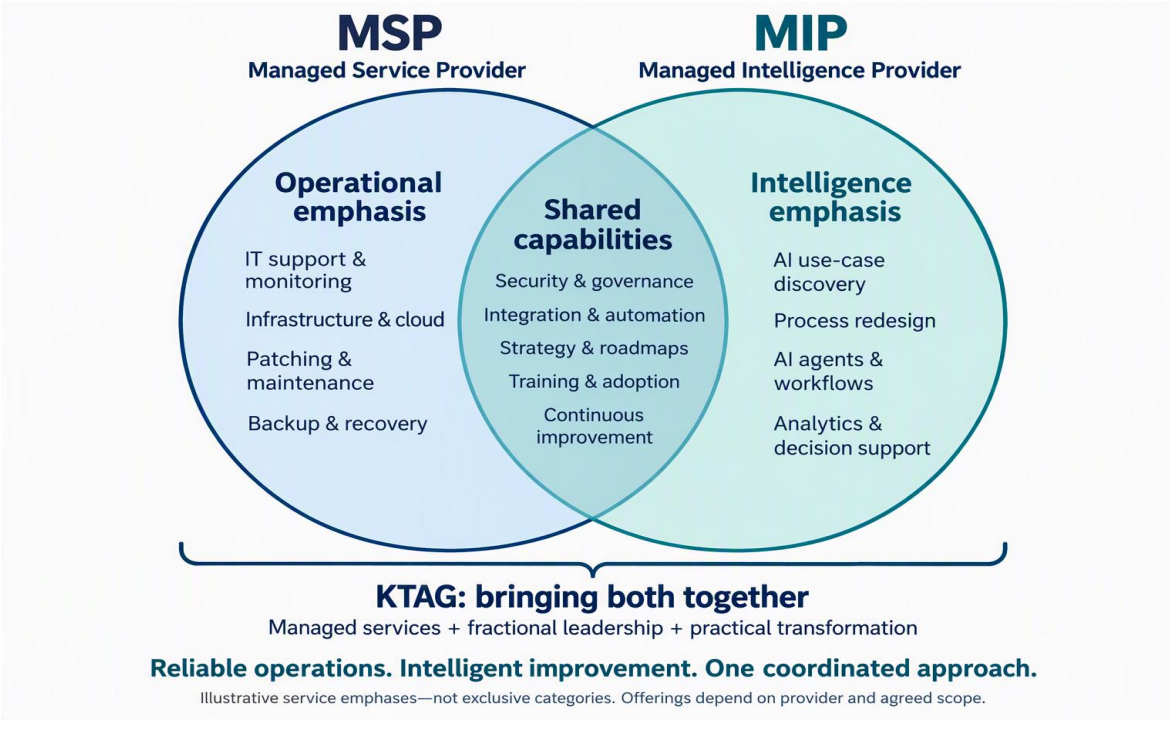
What is the difference between an MSP and an MIP?
Why KTAG gives clients the best of both worlds
In today’s ever-changing marketplace, relying on your existing ecosystem for answers is not always enough. Without a coordinated approach, even capable technology vendors and service partners can leave gaps between what your systems deliver and what your business actually needs. The question is not whether your partners are doing their jobs; it is whether their work is aligned with your business objectives. That is where the distinction between a Managed Service Provider (MSP) and a Managed Intelligence Provider (MIP) becomes useful. Businesses need dependable technology, but they also need the insight and leadership to improve how work gets done. These are complementary needs—not competing choices.
The MSP: a dependable operational foundation
An MSP takes ongoing responsibility for an agreed range of IT services. These commonly include user support, monitoring, patching, infrastructure management, backups and security services. The objective is to keep the technology environment available, maintained and supported so people can do their work.
The MIP: connecting technology to business improvement
A Managed Intelligence Provider extends the emphasis to how people, processes, data and technology work together. In the emerging AI services market, this includes identifying useful applications for AI, integrating automation into workflows, and managing those solutions with appropriate oversight and ongoing improvement. MIP is an emerging term rather than a universally standardized service category. Clients should therefore look beyond the label and ask what a provider will actually assess, deliver, govern and support. Intelligence should mean more than access to another software tool: it should connect informed judgement with practical execution. The central MIP question is: “How can our technology and information help the business work better?”
The difference is one of emphasis and accountability. Operational measures such as availability and response times remain essential. A business-improvement engagement adds agreed measures such as processing time, rework, information quality, adoption and cost per process. Neither set of measures replaces the other.
Why KTAG brings the best of both worlds
At Kornerstones Trusted Advisory Group (KTAG), we bring managed services, fractional business and technology leadership, and process transformation together. Our approach combines the operational discipline businesses need today with the expertise to plan and implement what comes next.
Start with the business—not the product
Our methodology begins with discovery, analysis and assessment: understanding the current environment, mapping processes, checking service commitments against business needs, and identifying gaps. Only then do we move into planning, building and managing the changes. This helps keep technology investment connected to a defined business purpose rather than starting with a tool and searching for somewhere to use it.
Connect senior judgement with hands-on delivery
KTAG’s fractional model provides access to senior business and technology expertise without requiring a full-time executive appointment for every need. Technology strategy, governance, vendor management and project oversight can be connected with implementation and operational support. Clients can scope the expertise and delivery capacity around their priorities.
Make intelligence practical
For us, intelligence includes the combined experience of our professionals as well as the appropriate use of data, AI and automation. Our capabilities include process mapping, readiness assessments, workflow automation, dashboards, training and implementation. The aim is not to automate everything; it is to identify where change is worthwhile and build a solution people can use.
Keep governance and operations connected
Improvement should not come at the expense of reliability or control. KTAG brings privacy, risk management and governance expertise alongside its business and technology services. An engagement should clearly define responsibilities, support arrangements, data access, human oversight and how success will be measured. Specific service coverage and commitments depend on the agreed scope. That is the combined value: reliable operations, intelligent improvement and one coordinated approach. It can also mean strengthening an existing provider relationship rather than replacing it. KTAG’s fractional and partner-delivery services can complement capabilities already in place.
What this could look like in practice
Illustrative scenario—not a reported client result.
Consider a distributor whose systems are functioning well, but whose order-processing workflow still relies on repeated data entry, emailed approvals and manually assembled reports. Its IT services may be meeting their commitments while the business continues to experience delays.
The MSP contribution is to maintain the supporting environment: access, applications, infrastructure, backups and user support within the agreed service scope. The MIP contribution is to examine the workflow itself: where information is duplicated, why approvals stall, which data can be trusted, and where integration or automation would help.
A combined engagement could map and simplify the process, connect the relevant systems, introduce appropriate automation, train users and assign clear ownership. Where AI adds value, it would be introduced with testing and human review suited to the task. Progress could be measured against a baseline using order-processing time, exception rates and manual effort—not simply whether a new tool has been installed.
The best choice is not an acronym
Businesses should not have to choose between keeping operations dependable and making them better. They need a partner who understands both the technology foundation and the business that depends on it.
KTAG brings those perspectives together through managed services, fractional leadership and practical transformation expertise. Our role is to help clients connect today’s operational needs with tomorrow’s priorities, with a scope and level of support that fit their organization.
Run reliably. Improve intelligently. Evolve with purpose.
If your technology is working but your processes are holding you back—or your plans for growth need stronger operational support—let’s discuss where KTAG can help.
Contact us today. eraymond@ktag.consulting